Friday, July 15, 2016

Musings: Dark Days

It doesn't get much darker than this, moaned the anti-GMO groups, when confronted with the new labeling bill that President Obama is expected to sign into law.

Which underscores just how screwed up their priorities are. Really? A deadly drought is hammering East Africa, 84 people in France were just mowed down by a terrorist, cops and citizens are killing each other in America and a fricking food label is the darkest thing on the horizon?

Still, I can't help but chortle when I see Andrew Kimbrell, director of Center for Food Safety, sputtering and wringing his hands in despair. Whassa matter, Andy? Worried about losing one of your longest-running fundraising gambits, the demand for labeling?

Or are you just whimpering because you gambled, and lost, when you believed that teeny-tiny Vermont would serve as a labeling model for the nation? You folks pushed, and Congress pushed back and voided Vermont. So suck it up and deal.

Kimbrell and crew took a similar gamble in Hawaii with the anti-GMO bills they pushed through here. The Hawaii laws have nothing to do with protecting anyone (save CFS's fundraising machine) and everything to do with establishing a precedent for supposed “home rule,” which groups like CFS define as their right to meddle in local affairs.

Thus far, however, the courts have dealt the antis a losing hand, firmly establishing the pre-emption authority of state over counties in these matters. We'll see whether the Ninth Circuit Court of Appeals solidifies that authority further, as it appears inclined to do.

It's also fascinating to watch these guys whine about how the law keeps people in the dark, when the anti-GMO groups themselves are so very non-transparent about their own funding and actions. To use their line against food manufacturers, if you've got nothing to hide, why aren't you disclosing?

Speaking of which, I see that Kauai House candidate Fern Rosenstiel is promising: “Personally I will work to develop a strong reputation for very transparent and clear decision-making relating to all positions I take.” So why not start, Fern, by disclosing the finances of your anti-GMO group, Ohana O Kauai — like who gave you money, how much and where it was spent? Also, how much have you gotten in crowd-sourcing, and did you declare it as taxable income? And why are you giving your occupation as “environmental scientist” when you're a bartender at Tahiti Nui?

Meanwhile, the labeling issue is becoming increasingly moot, anyway, since the USDA has declined to regulate crops modified through the new process of gene-editing. First up: canola oil rich in omega 3 fatty acids and mushrooms that resist browning with age. Also in the works: genetically-edited soybeans that produce oil able to withstand high cooking heat without producing trans fat; low-gluten wheat and potatoes with fewer neurotoxins.

Though the antis have lost labeling as a powerful fundraising tool, they can still simplistically exploit many other complex issues, such as pollinator health. The Hawaii Branch of CFS just came out with a scary schtick in which they are trying to blame pesticides for the decline of native Hawaiian birds — uh, guess they never heard about habitat loss, avian malaria and rat/cat predation — while painting a dire picture of honeybee health.
In fact, Hawaii's managed honey bee colonies are among the healthiest in the nation. There has been no colony collapse disorder in the Islands, and there's a hearty feral bee population. The greatest risks to Hawaii bees are the varroa mite and small hive beetle, but they're not sexy fundraisers, so CFS focuses on pesticides.

In the real world, pesticides are but one of many threats facing pollinators. Scientists are now starting to suspect a new culprit in the decline of bees: soaring levels of carbon dioxide associated with global warming. As Yale Environment 360 reports:

The adverse impact of rising CO2 concentrations on the protein levels in pollen may be playing a role in the global die-off of bee populations by undermining bee nutrition and reproductive success.

Though beekeepers can supplement with protein patties in the fall, no such option exists for native bees, which actually do the lion's share of pollination. 

 Meanwhile, high CO2 levels are affecting more than protein levels in pollen:

Samuel Myers, a senior research scientist at Harvard’s School of Public Health, has published groundbreaking studies on how rising CO2 levels lower the nutritional quality of foods that we eat, like rice, wheat, and maize, which lose significant amounts of zinc, iron, and protein when grown under higher concentrations of CO2.

“We are fundamentally transforming all of the biophysical conditions that underpin the global food system,” said Myers. “Global food demand is rising at the same time the biophysical conditions are changing more rapidly than ever before.”

To quote Mr. Toad: “Hold on to your hat, because away we gooooo.....”

Thursday, July 14, 2016

Musings: On Us

You wake up one day, and five police officers have been killed in Dallas.

You wake up a different day, and people are glued to their phones in an obsessive search for Pokemon.

You wake up every day and another American citizen — or two or three or five — has been killed by a gun, not infrequently wielded by a toddler.

The media treat all these events as worthy of equivalent coverage.

And perhaps they are, in terms of what they tell us about us.

Pokemon was born, back in 1990, by a designer seeking to combine his love of video games with his childhood passion for collecting insects.

Now insects — the woefully misunderstood, largely unstudied animals essential to our existence — are declining dramatically in many parts of the world, due in large part to us. 

But few of us notice, and even fewer care, our attention diverted from the natural world we actually live in to the virtual world within our phones.

Which is how an electronic game comes to be deemed “an inescapable force of nature,” on par, say, with tornadoes, hurricanes, tsunamis.

“Billionaires can't buy Bernie” reads the bumper sticker on a Lexus SUV, spotted on the day that Sanders endorses Hillary Clinton. 

And so one revolution of rhetoric fizzles as yet another revolution of rhetoric flourishes:

In countless collisions of color and creed, Donald J. Trump’s name evokes an easily understood message of racial hostility. Defying modern conventions of political civility and language, Mr. Trump has breached the boundaries that have long constrained Americans’ public discussion of race.

On the internet, Mr. Trump is invoked by anonymous followers brandishing stark expressions of hate and anti-Semitism, surprisingly amplified this month when Mr. Trump tweeted a graphic depicting Hillary Clinton’s face with piles of cash and a six-pointed star that many viewed as a Star of David.

“I think what we really find troubling is the mainstreaming of these really offensive ideas,” said Jonathan Greenblatt, the national director of the Anti-Defamation League, which tracks hate groups. “It’s allowed some of the worst ideas into the public conversation in ways we haven’t seen anything like in recent memory.”

"It's so sad when voters are forced to choose the lesser of evils," bemoans my 98-year-old hanai mom, who has seen the world repeatedly turned upside down by the worst in us: racism, fascism, totalitarianism, terrorism, ignorance, apathy, greed and fear.

On Kauai, meth addicts rage, homeless pack the parks, feral cats devour endangered birds, agriculture struggles, roads clog, sewers overflow, the landfill towers. And the County Council indulges in distractions like dog doo and parents smoking in cars.

The bakery case offers a “paleo cookie” for $3.75. The hungry line up at food pantries, grateful for a box of sweet, stale snacks among the canned goods. 

Countless hours, untold amounts of cash, are expended in a bitter fight over how to disclose the role of a plant breeding technology in the production of processed food in the world's wealthiest nation. “Mothers have the right to know what they're feeding their children,” we are told.

And every 5 seconds, a child starves to death — up from one every 10 seconds just five years ago.

“The real evil with which we have to contend is not the physical evil of the Famine, but the moral evil of the selfish, perverse and turbulent character of the people.” — Charles Trevelyan, British civil servant and colonial administrator

We are outraged. We are outraged by the outrage. We are outraged by the outrage over the outrage.

And yet the status quo churns on:

Tuesday, July 12, 2016

Musings: Power Grab

Hawaii anti-GMO groups are pushing their candidate slate hard in the upcoming Primary, offering more evidence that securing political power is their underlying goal.

But with nearly all of the funding for these groups coming from outside Hawaii, the question becomes, who really benefits if their power grab succeeds?

The most vocal entity in this political machine is the Hawaii Center for Food Safety Political Action Fund. Tax documents show that its parent organization, Center for Food Safety, took in $3.5 million in 2014. CFS spent $738,569 on the Hawaii office that year, and a total of $425,000 on lobbying. But that's all the information that it has disclosed, and it has yet to release its 2015 return.

So Hawaii voters have no way of knowing who is bankrolling the group's political activities in the Islands, or how much the Washington,D.C.-based CFS is spending to influence elections here.

Other players are the tawdry Babes Against Biotech, which echoes CFS stances and reposts its social media memes; the smarmy Kuleana Coalition for Change, which is soliciting “anonymous” donations to support Maui candidates on the CFS slate; and HAPA, the political advocacy group masquerading as an educational nonprofit, which was founded by Kauai Councilman Gary Hooser and trained several of the slate candidates through its Kuleana Academy.

According to its 2014 tax return — 2015 is not yet available — HAPA has spent its money producing propaganda and holding meetings. Though I previously disclosed that HAPA had received a grant from CFS, HAPA has not disclosed any of its funders.

So how is this totally non-transparent political machine working to influence elections? Using the same kind of deceptive, fear-mongering tactics that have characterized all of its actions in Hawaii:
The CFS PAC is hosting “virtual phone banks,” where callers are directed to share messages like:

Our keiki can't vote for legislators who will protect them from pesticide drift, but we can and it's up to us!

Join citizen volunteers across Hawai'i calling voters from home to make a proven difference for our keiki! Starting at 3PM, a quick and easy training online then jump on the phones to help change Hawaii's agricultural future forever.

[CALLING ALL FOODIES] We need your help! One of the most effective ways to create real change is electing leaders who share your values and will pass legislation to create the future we all want to see for Hawaiʻi!

The "future we all want to see for Hawaii"? I'm reminded of the old Lone Ranger-Tonto joke, with the punchline, “Who is 'we,' white man?"

In order not to run afoul of the IRS, the CFS PAC claims to be “a non-candidate, non-partisan, not-for-profit committee. The activities of this committee are not conducted in coordination with any individual candidate.”

No, not any individual candidate, just their “true food” slate of candidates. Oh, and Rep. Kaniela Ing, since they're doing a phone bank for him. And one for Tiare Lawrence, who is also seeking to represent Maui in the state House.

They've also got a little deal going with Sen. Russell Ruderman, who is facing Councilman Greggor Ilagan in the Democratic primary. In soliciting volunteers on the Big Island, the CFS PAC promises those who “reach the most voters” a $10 gift card to Ruderman's store, Island Naturals. Kinda sounds like "coordination with an individual candidate to me."

Though its funding is non-transparent, the group has been quite clear about the sort of politics it supports. It recently lauded Rep. Chris Lee's $2 million organic tax credit bill:
Besides discriminating against small conventional farmers, the bill was passed through the reprehensible “gut-and-replace” method, earning it this year's Rusty Scalpel Award from Common Cause Hawaii and the League of Women Voters. According to League President Ann Shaver:

“This makes a travesty of the democratic process.”

How ironic, then, that it's celebrated by the very same folks who have joined a campaign claiming Monsanto is “poisoning democracy” by challenging the Maui GMO moratorium in court.

The group is also quite open about how it will influence Hawaii elections:

We will use your donation to:

Pay phone bankers and canvassers to get out the vote
Send educational mailers to voters in key legislative districts
Buy ad space in local newspapers and counter the agrichemical industry’s messaging in corporate media.

Which raises another question: Are local voters truly served by candidates running on a very narrow pro-organic, anti-pesticide, anti-GMO, anti-conventional farming platform?

Meanwhile, Hooser is desperately seeking to broaden his appeal among local voters, which prompted him to record a backyard video for Facebook, in which he tells us, in a weird third person narrative:

Nobody likes smoke meat, or likes a BBQ, more than Gary Hooser does.

He's madly trying to distance himself from his failed fireplace bill, which, despite his protestations to the contrary, most assuredly could have been used to ban backyard barbecues, smoke meat, cooking in imu, or the roasting of marshmallows on an open fire, as well as torch lightings, fireplaces or the burning of wood, charcoal or gas.

Though Hooser has his loyal sheeple, many others are smart enough to see through his shibai:

Kalani Kapuniai Nobody likes smoke meat more then the guy who tried to stop us Hawaiians from actually making smoke meat... Let the fires smoke! Let the dogs bark! Time to wake up Kauai‬. I'm not well educated in politician terms but I do know what's going on. And I know this is election year, and to win in an election you need to cast a large number of votes.. And I can help you with that. Go make it right with the real people and leave the puppet shows for story time in keiki corner.. And trust me... Those are where the votes come from... People vote for real people‬.

Listen up.

Friday, July 8, 2016

Musings: No True Purpose

Friends of Mahaulepu (FOM) is ramping up the fear machine against Hawaii Dairy Farm as the deadline for commenting on the project's draft EIS nears.

Two new radio ads feature staged conversations between FOM board members Bridget Hammerquist and Eileen Kechloian, who level all sorts of false, frightening claims against the proposed dairy.

The first ad goes something like this: “How are things? Oh, they're not good, I'm really worried about Mahaulepu (mispronounced) Valley; all that manure, over 2 million pounds, going down that valley and into the ocean; they now admit they're going to pollute; oh, and the grass-fed, that's gone, too.”

Every single one of those claims is complete and utter bullshit.

The other ad continues the distortion: “I heard the cows are pregnant” – uh, duh, how else do you think think they're going to make milk? – “they only have five fulltime jobs here, but there are 2,618 jobs on the southshore, and that odor and biting flies is going to affect jobs terribly.”

Actually, if you read the draft EIS — as these two lying wahine claim they have — you'll find:

It is estimated that just 2 percent of the nitrogen and 1 percent of the phosphorus produced have the potential to runoff the farm — levels that will not adversely affect ocean water quality or the marine environment.

Air quality in the immediate vicinity of the dairy farm (within 1,700 feet) may, in the worst-case conditions, be affected with odors from the effluent pond and manure in the pasture paddocks. The odor extends to approximately 2,780-feet (about half a mile) for the 2,000-cow operation. However, the nearest homes, recreational areas and commercial centers are more than a mile away.

The DEIS also outlines measures that will be taken to prevent flies from becoming established at the dairy, and there's no indication they will travel a mile to the closest homes.

Whether one supports the dairy or not, I think most pono people would agree that it's wrong to deliberately frighten and deceive others to advance one's agenda. But that's the strategy embraced by FOM and other vociferous opponents of the dairy, including Councilman Gary Hooser, Surfrider and Hawaii SEED's Jeri DiPietro, all of whom used a similar approach to push the anti-GMO/anti-seed company agenda.

So is this the new normal in dealing with agricultural uses of ag land? Mobilize opposition through scare tactics? Stubbornly cling to false beliefs and claims, even when they've been proven false? Throw tons of shit against the wall and see what sticks?

FOM is also bringing in John A. Kilpatrick, who runs a real estate advising firm, to further scare folks with alarmist talk about how the dairy will trash their property values. And that leads us to the real crux of the issue.

Much of the money raised to fight the dairy has come from condo owners at Poipu Kai, which donated first $10,000 and then $40,000, and Jay Kechloian, a Seattle builder-developer who showed how sleazy he is by fighting design standards and an ordinance that prevented construction of two houses on substandard lots in that city.

Though this issue is typically framed as “protecting Mahaulepu,” it's really about protecting their own economic interests from a perceived threat. So do we let the self-interested few destroy a viable venture that can actually help create the local, diversified ag that so many of the dairy opponents are also screaming for?

While we're on the topic of false claims, folks are repeating the lie that Mark Zuckerberg' security guards are trying to keep people from using the public beach. No, they're just striving to control the daily influx of trespassers who want to get on the land and take pictures. The guards tolerate those who encroach hundreds of feet in from the beach. But once the curious start to breach the interior, they're told to return to the beach.

There never has been any public beach access through the land Zuckerberg bought, and he's under no requirement to provide it. Folks can still use the same legal public access ways that have always been available to reach Pilaa and Waipake beaches: Either rock hop from the Waiakalua or walk from Larsen's (Lepeuli).

The county could have had an access to Waipake through the Kahuaina part of the Zuckerberg land, back when it was owned by Falko Partners.  But Hooser and Councilman Mason Chock, egged on by a few disgruntled citizens, kept pushing for more

Meanwhile, the property was placed on the market. So when Zuckerberg bought the land and relinquished the entitlement for up to 76 CPR lots — there was never any permitting for affordable housing, as Allan Parachini mistakenly asserted — the access requirement was eliminated.

Don't blame Facebook boy. Blame the pandering politicians and misguided citizens who screwed up the chance for a public access there.

Speaking of pandering politicians, Sen. Bernie Sanders is desperately trying to retain some relevance in the wake of his failed presidential bid by opposing a bi-partisan GMO labeling bill that would actually affect more products that his home-state labeling law. 

Despite Bernie's best efforts, the Senate closed debate on the legislation and is expected to approve it soon. It would create a national system that gives food manufacturers these labeling options, which certainly seem sufficient:

Use a government-sanctioned US Department of Agriculture (USDA) symbol on packaging.
Print a label using plain language.
Print a QR code on food packaging that shoppers can scan.

But as the New York Times reported:

Proponents of labeling insisted that nothing short of text on packages would do.

How ironic that these who have clamored most loudly for labeling are now opposing it because it's not exactly what they want. 

They're all for transparency when it applies to someone else. But as I've drilled down in these anti-GMO groups, I've consistently found that they reveal very little about their own income, expenses and operations. To apply their argument about labeling, if they're proud of what they do, why won't they disclose?

Unless, of course, they have no true purpose aside from making trouble for others: 
See what I mean?

Wednesday, July 6, 2016

Musings: A Conversation

I walked into a health store, which shall remain unnamed, and the following conversation ensued:

Clerk: Can I help you find something?

Me: Do you have any of the Burt's Bee's lipsticks?

Clerk: No, we stopped carrying them when they got bought out by Clorox last year. But we have many other lipsticks.

Me: Is that how you decide what to carry, based on who owns the company?

Clerk: It's one way. Do you want to be responsible for everything Clorox does?

Me: No. But sometimes I do buy Clorox bleach.

Clerk: They're a horrible corporation. Have you seen their record?

Me: No. But like a lot of your customers, I drove here, using gas from Exxon, Shell or Chevron. So we can't exactly claim to be pure.

Clerk: Yeah, well, it's better to support small companies if you can. Here's a product you might like. It's hemp organics. It's a better product than Burt's Bees.

Me: It's certainly more expensive.

Clerk: You're helping a small company. And it doesn't have any of those GMOs.

Me: I'm not against GMOs.

Clerk: Oh. (Scathing tone.) Well, the rest of the world is.

Me: No, they're not.

Clerk: Europe, South America, Asia – they're all against it.

Me: You'll find GMO crops in all those places, and the ones that aren't growing it import GM animal feed. It's mostly just Europe that's opposed.

Clerk: And South America.

Me: Argentina and Brazil are really big into GMOs.

Clerk: They're fighting it in Mexico. There's a big movement to stop them taking over their corn.

Me: I understand the value of protecting indigenous seeds, but some GM technology could actually help do that, by making the land races more hearty.

Clerk: But look at what glyphosate is doing to our food supply. It's in everything.

Me: Well, some biotech traits are working to reduce pesticide use, like the Bt products. So you can't just lump it all together as roundup-ready corn.

Clerk: None of it's good for you.

Me: Did you see the American Academy of Sciences study that just came out? They said there are no health problems associated with GM crops and foods.

Clerk: Oh, studies like that are coming out all the time.

Me: Then why won't people believe them?

Silence.

Clerk: Well, I say keep it natural as long as you can.

Me: Whatever that is.

Tuesday, July 5, 2016

Musings: More to the Story

When activists and others want to make a point, they're often very selective in the information they present, and omit.

A case in point is Bill 2501, which allows A&B and other users to temporarily keep their revocable water permits while the system is revamped. Activists roundly criticized both the Lege and gov for “selling out to corporate interests” and “abandoning East Maui farmers.”

But what they didn't mention was how the Lege appropriated $1.5 million for a grant program, administered by the Hawaii Agribusiness Development Corp., aimed at helping East Maui farmers improve their land to both accept the water that will be returned to eight streams and increase the profitability of their farms.

And when activists claimed that A&B is still “hogging” water, despite a court order requiring the company to restore the flow in those eight streams, they never mentioned that flows have been restored on three streams. But it was determined that restoring water to the other five streams could cause floods downstream, damaging farm land and structures. So the Lege allocated $3 million to improve state-owned land along the five stream beds to safely accommodate the restored flows.

What's more, the Lege allocated funds for two new positions so the state Department of Land and Natural Resources can establish the in-stream flow standards required for the Water Commission to allocate surface water. Though every stream in the state is supposed to be assessed, priority will be given to streams affected by revocable permits so the agency can process the longterm permit applications in a timely fashion.

Though activists have denounced biofuels, and the genetically engineered corn and soy that typically produce them, SciDev.Net reports that a laboratory study in Brazil has found that diesel made from soybeans is less toxic to human lungs than other fuels.

“Investing in research on biofuels is, without a doubt, a mid- or long-term solution to reduce emissions of toxic contaminants in the atmosphere and prevent disease,” says Solange Cristina GarcĂ­a, a toxicologist at the Federal University of Rio Grande do Sul, also in Brazil.

Though organic advocates decry the use of pesticides in conventional crops, and claim their products are healthier, they've failed to disclose that “organic pesticides pose the same health risks as nonorganic ones,” according to evolutionary biologist Christie Wilcox. 

Take neem oil, which so many “natural” gardeners/farmers treat like holy water. But “the stuff is known to cause seizures and comas in humans if consumed in large doses, and it kills bumblebees at very low concentrations,” reports Henry I. Miller, a Stanford University physician and molecular biologist. He continues:

A 2012 report by researchers at Stanford University’s Center for Health Policy analyzed data from 237 studies to determine whether organic foods are safer or healthier than nonorganic foods. They concluded that fruits and vegetables that met the criteria for “organic” were on average no more nutritious than their far cheaper conventional counterparts, nor were those foods less likely to be contaminated by bacteria such as E. coli or salmonella.

What's more, “organic foods amounted to 7% of all food units recalled in 2015, even though organic farms account for only about 1% of agricultural acreage."

And finally, it seems like folks are always clamoring to pull up the drawbridge once they've settled in to a place. An example is yesterday's letter to the editor from Michael Wells of Moloaa:

Kauai has become a zoo with too many people and cars and too little infrastructure to handle the massive immigration of folks seeking a “better life.” Can’t we just take a break and put a moratorium on further development until the infrastructure can catch up?


[A] growing body of economic literature suggests that anti-growth sentiment, when multiplied across countless unheralded local development battles, is a major factor in creating a stagnant and less equal American economy.

Unlike past decades, when people of different socioeconomic backgrounds tended to move to similar areas, today, less-skilled workers often go where jobs are scarcer but housing is cheap, instead of heading to places with the most promising job opportunities, according to research by Daniel Shoag, a professor of public policy at Harvard, and Peter Ganong, also of Harvard.

One reason they’re not migrating to places with better job prospects is that rich cities like San Francisco and Seattle have gotten so expensive that working-class people cannot afford to move there. Even if they could, there would not be much point, since whatever they gained in pay would be swallowed up by rent.

[W]hen zoning laws get out of hand, economists say, the damage to the American economy and society can be profound. Studies have shown that laws aimed at things like “maintaining neighborhood character” or limiting how many unrelated people can live together in the same house contribute to racial segregation and deeper class disparities. They also exacerbate inequality by restricting the housing supply in places where demand is greatest.

The lost opportunities for development may theoretically reduce the output of the United States economy by as much as $1.5 trillion a year, according to estimates in a recent paper by the economists Chang-Tai Hsieh and Enrico Moretti. Regardless of the actual gains in dollars that could be achieved if zoning laws were significantly cut back, the research on land-use restrictions highlights some of the consequences of giving local communities too much control over who is allowed to live there.

“You don’t want rules made entirely for people that have something, at the expense of people who don’t,” said Jason Furman, chairman of the White House Council of Economic Advisers.

Ironically, Councilman Gary Hooser, whose nonprofit HAPA was founded in part to address social inequity, has supported a moratorium on new development.

Sunday, July 3, 2016

Musings: Y'Hear?

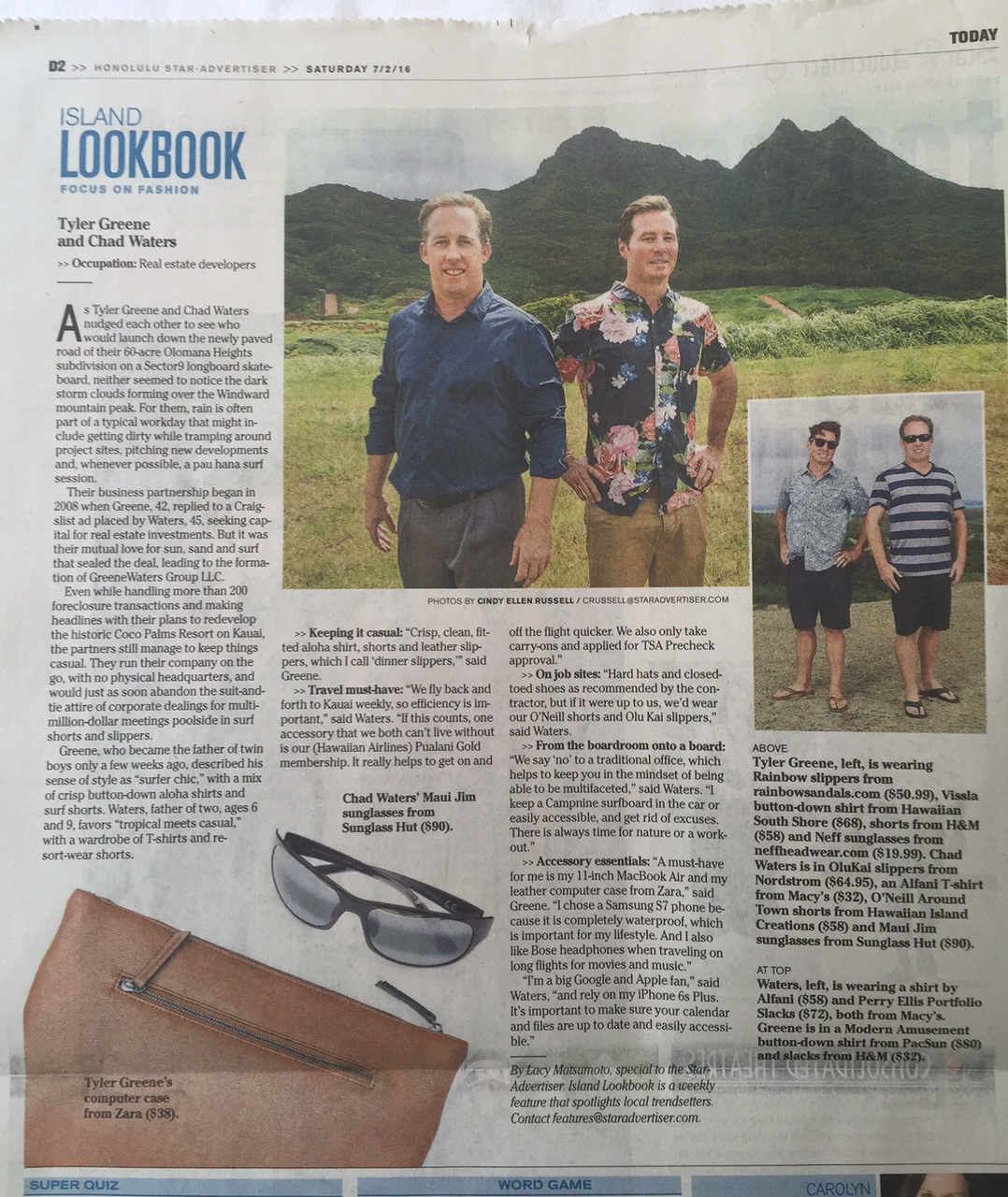
You'll be reassured to learn the guys behind the Coco Palms renovation aren't just a couple of shady, fly-by-night developers. They're fashionistas. Or what passes as such in Hawaii.
Yeah, Tyler Greene is “surfer chic” and Chad Waters is “tropical meets casual.” Style tips: Maui Jim shades — bet you never would've thought of that — and an upscale (thirty-eight whole dollars) leather computer case.

What really caught my eye, though, was how the two met — on Craig's list, where Waters was seeking capital for real investment. Heck, isn't that where all the high-grade developers get their dough? In amongst the “mom son breeding season” (gack) and “MAKE $$$ WATCHING 5 COMMERCIALS A DAY!!!” ads? 

But then, it perfectly suits their “casual” approach to business, which means “no physical headquarters” where pesky collection agencies and process services can track you down when all that flaky financing goes to shit.

Hopefully they'll at least get some of the rat-infested buildings torn down before that happens. And thank you, planning director Mike Dahilig, for not handing them a construction permit just yet.

Next up for planners: Mark Zuckerberg's farm dwelling agreement. Uh, really? As in FarmVille-style? 

The election season is heating up, with folks holding sign, attending fundraisers and endorsing their favorites:
Poor Dustin. He doesn't seem to realize there already is a hotel in Haena, besides the Colony Resort. Add up all the vacation rentals — the ones he's never spoken against — and it's equal to a couple of hotels — with none of the supportive infrastructure or union jobs. Clever, yeah? So clever he never noticed.

More poor Dustin: He doesn't seem to realize that Neidine — Nadine to the rest of us — and Fern are running for the state House, which means they'd have zip authority over Black Pot park, Kapaa development or the Hanalei Ridge project. That's the county's kuleana. But hey, Dustin knows the first rule of an akamai activist: never let the facts, much less the truth, get in the way of a good smear/slam.

I liked Kauai Souljah's endorsement for Fern:
Yeah, you, too, could be slinging drinks at the Nui. Now that's what I call quality living for everyone.

Of course, all this local election stuff could well be moot (or mute, as Dustin would doubtless say):
Nothing's worse than the dreaded term oil. Except, of course, chem trails:
Ya know, I really haven't seen much of that soft, passive, feminine energy manifesting around the globe. Still, only truly craven conspirators would value that over big-body machismo.

Oh, and just in case Maui voters are wondering whom to avoid, here's Dustin's endorsement for the Valley Isle:
Speaking of Maui, one of its most obnoxious citizens, Karen Chun, is unhappy with Mina Morita, former director of the Public Utilities Commission. Mina has been blogging intelligently about Gov. Ige's questionable appointment of Tom Gorack to the PUC and everything it represents:

[I]t is a great opportunity for a civics lesson to understand the separation of powers, the hierarchy of laws, the delegation of authority, the role of regulation, the making of policy and, ultimately, figuring out how far a State agency can intrude into a business transaction between two private parties under the guise of protecting the public interest and whether facts, logic, reason and the rule of law will prevail or succumb to an abuse of power.

Come Tuesday and in the following days, we will see whether the rule of law will be pursued or ignored in two possible venues.  The first would be the Senate asserting its constitution given duty and right to retain its powers of advice and consent.  The second is the right of any individual to start a quo warranto proceeding (Chapter 659) to petition the court to order Tom Gorack to state the authority under which he can claim to be a PUC commissioner.

Mina's reasoned thoughtfulness prompted this response from Karen:
Yup. She would. Because the rule of law means nothing to anti-everything folks like Karen, who operate under the belief system that the ends justify the means.

Which brings us to Ashley Lukens, director of the lying, fear-mongering Hawaii Center for Food Safety. She's all giddy about her latest chance at indoctrination:
It's a tad ironic that Ashley's a passenger on the Peace Boat, considering her raison d'ĂŞtre is waging war on GMOs and conventional agriculture.

But hey, she's the perfect person to be talking about “the role that colonialism and agriculture play in shaping [Hawaii's] social, economic and political landscape.” After all, the anti-GMO movement is the epitome of neo-colonialism, what with wealthy, white, well-fed elitists telling others how to eat, farm and live around the world.

And CFS is desperately seeking to replicate the Hawaii missionary model, replete with off-shore funding, an unwavering ideology and die-hard disciples preaching fervently about Monsatan and lost shill souls.  

You'd think Islanders would be wise to this strategy by now. Because all this phony self-righteousness is a guise for their true intentions: grab control of water and land, and thus power. Oh, and kick down some kala while you're at it.

Which leads to this, from the excellent Risk Monger blog:

Friday, July 1, 2016

Musings: Chief Perry Vindicated

It's taken more than four years, but an appeals court has vindicated Kauai Police Chief Darryl Perry, ruling that Mayor Bernard Carvalho Jr. had no authority to suspend him in February 2012.

The seven-day suspension, which was publicized throughout the state, was a blot on Perry's otherwise stellar professional record.

It also created a cascading domino effect among KPD personnel that tarnished several careers and most recently manifested in Assistant Chief Mark Begley's discrimination and retaliation suit against KPD and the county.

Following the suspension, the Kauai police commission unanimously voted to reinstate the Chief. But Carvalho refused to allow him to return to work, resulting in a humiliating showdown at KPD, when Begley thrice refused Perry's direct order to return his badge and gun.

When Perry finally returned to work, he attempted to take action against Begley for insubordination. Begley then took medical leave, and has never returned to work. The mayor said police commissioners had to determine who had authority to suspend the chief before dealing with Begley's insubordination complaint.

Commissioners went to court, arguing that only they had authority under the county charter to hire, fire and discipline the chief. Circuit Judge Randal Valenciano, a former Kauai County Councilman, ruled that the mayor, as the county's chief executive officer, had power over all departments.

Commissioners then appealed that ruling to the Intermediate Court of Appeals. The ICA noted in its ruling that the charter does not explicitly provide an answer, and both sides made good arguments.

But the ICA ultimately determined that the commission's power to discipline the chief is implied in its sole authority to hire and fire him. It cited a Massachusetts court ruling that had determined “it would be strange indeed” if an entity had only the authority to remove, but not impose a lesser punishment. 

The ICA also noted that the Charter gives the mayor a voice, but no vote, in the commission's proceedings.

So will the chief sue the county for wrongful suspension? Will the mayor publicly apologize to the chief for dragging his name through the mud and causing him to lose face at KPD? And how will this ruling affect Begley's case? 

All that remains to be seen, but the chief did issue this statement:

"I am thankful to the Kauai Police Commission for appealing Judge Valenciano’s decision and grateful that the Intermediate Court of Appeals reviewed all of the facts and came to the right conclusion that the Mayor had no authority to do what he did.  With this decision, all of the police commissions and Mayors throughout the State will have clear guidelines with respect to their lawful authority."