Making
electricity is not a pretty business, but gosh, don't we love it when
the lights come on and the refrigerator hums and the router connects
us to the cyber superhighway? And don't be getting all smug
thinking, oh, I'm clean and green, off the grid, because garans,
there's ugliness in the manufacture and shipping of your batteries
and PV panels.
Anyway,
the folks on our little island suck down 73 megawatts of electricity
at peak consumption, much of it generated by burning naptha at the
Kapaia power plant and low-sulfur diesel at Port Allen. Though “we
run the cleanest plants in the state,” according to KIUC spokesman
Jim Kelly, there's no escaping the fiscal and political
vulnerabilities — not to mention the carbon emissions —
associated with using fossil fuels shipped in from Indonesia or some
other far away place.
So KIUC
is moving into renewable energy sources, like solar, biomass and
hydro, which is how I found myself in a painted eucalyptus grove near
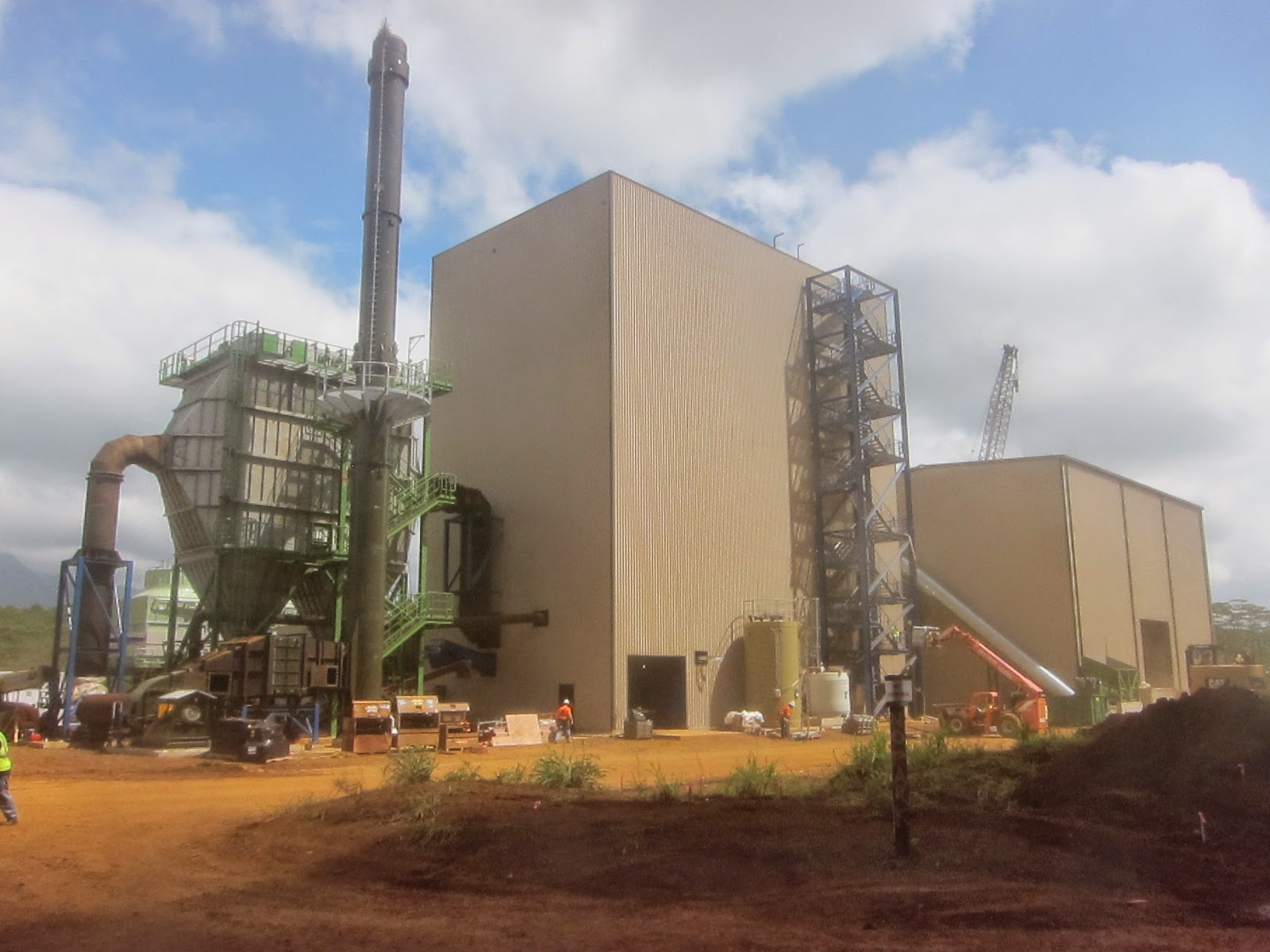
Halfway Bridge where a major industrial project is in the works.
It's the
Green Energy biomass plant, where eucalyptus and albezia trees —
some of them wild, some grown in plantations — will be cut down,
chipped, stored in a 10-story-tall building and then fed, via
conveyor belt, into a boiler that creates steam, turns the turbine and makes
electricity.
Men in
hard hats, safety vests and heavy boots buzzed around the site like
worker bees in a hive, as big and little trucks drove in and out.
Cranes towered overhead, and heavy equipment rumbled and roared,
moving piles of dirt as a stiff breeze kicked up billowing clouds of
dust.
The
blustery 64-acre site — five acres is being used for the plant,
with the rest in eucalyptus and albezia — seems well-suited to
wind generation. But we aren't going there on Kauai, because the
native seabirds have already been so devastated that they can't take
any more hits. And I got no problem with that.
Still,
it was a little amazing to think that in the 21st Century,
we're generating power by burning wood — though this very old
technology has been made super modern by the use of a German-made,
state-of-the-art facility that uses “electrostatic precipitators”
to filter out much of the crud. In other words, there is no belching
smokestack.
Under
its EPA air permit, its emissions will be significantly less than the quantities of nitrous oxide and sulfur oxide — one-fifth and one-third,
respectively — produced by burning diesel at the power
plants. Its particulate emissions will also be lower, and it's
billed as carbon neutral, which fossil fuels decidedly are not. Green
Energy conducted an Environmental Assessment and an EPA Environmental
Review, with no findings of significant impact.
KIUC
likes it because it uses fuel grown right here, giving us “a hedge
against craziness in the world,” which often translates into wild
oil price fluctuations and curtailed shipments, Kelly says. Another
advantage: it's “a firm energy source,” which means it can
produce 7 megawatts of power round-the-clock.
So what
about price? After all, the plant is costing $90 million, with
Standardkessel Baumgarte Contracting GmbH of Germany and Green Energy
(Eric Knutzen and Jeff Lindner) picking up the tab, aided by a $72.9 million federal loan guarantee. Green Energy will own and operate the
plant, selling electricity to KIUC.
Though
the state Public Utilities Commission allows utilities not to
disclose the exact costs of their power purchase agreements —
something about proprietary information and competitive bidding —
Kelly says it will cost consumers less than oil, which is about 25
cents per kwh now. The Green Energy plant will replace some 3.7
million gallons of imported oil burned in Kauai power plants each
year.
Mario
Scharf, a super smart guy from East Germany, has traveled the world
building these plants for Standardkessel Baumgarte Contracting GmbH,
which developed the technology and builds the equipment. He's in
charge of the getting the Green Energy facility up and running, which
hasn't been an easy task.
Though
it's the smallest plant they've built, it's been the most
challenging, with double the costs, he says. Why? Because the
Hawaiian Islands are the most remote inhabited land mass on Earth,
which means everything must be shipped in, and much of it from
Europe, since the U.S. doesn't make steel stuff any more.
Yes,
there's a reason why electricity is so expensive here, and it has
nothing to do with CEO David Bissell's salary. It's due to shipping
and no economy of scale. Though hey, we could be burning coal for 5
cents per kwh if we wanted to really get regressive.
In a
hellish logistical and scheduling exercise, they've brought in 300,
40-foot containers worth of stuff, much of it making a three-month
slog from Hamburg to Nawiliwili. About 200 guys are employed in the
construction, most of them Kauai residents.
The
plant and tree farms will employ some 39 fulltime workers when it
comes on line late this year. Green Energy's own guys will be cutting
the wood, which will be harvested, left in the field to lose about
half its moisture content, which takes a week or two, then chipped
on-site. It will be contracting with two or three local haulers to
bring the chipped wood into the plant, between eight and 14
truckloads per day, depending on where it's being grown. The chips will be stored in a 100-tall-building, prior to being fed into the boilers.
They
have four years worth of wood secured, including Bill Cowern's
Hawaiian Mahagony plantation. The company has clearing rights on
6,500 acres and long-term leases on about 2,000 acres, much of it at
Kalepa, where it plans to grow eucalyptus.
It takes
about four to five years for a seedling to reach cutting size —
eucalyptus grows 20 feet a year. The stumps will be left to regrow,
and then recut, a process that can be repeated four or five times
before the tree is all pau. Ash, the one residue from the plant, will
be used on the tree farms because its high nitrogen
content makes it a valuable fertilizer, Scharf says.
Green
Energy plans to harvest wild trees — don't freak out, we're talking
trash albezia that are threatening the water sheds, and non-native
eucalyptus — for the first four years while its plantations grow.
It also hopes to make use of the charred, mostly-eucalyptus trees
left from the Kokee fires, with a California logging company bidding
to remove the downed trees from the steep slopes so they can be
reforested with native trees.
The
plant can use only virgin wood – no pallets or construction debris
— and the sources can't be mixed, because soft trees like albezia
burn faster than eucalyptus. The company is currently allowed to
burn only those two types of trees, though it plans to seek an
amendment to its air quality permit to use the Kokee trees and other
wood sources that may become available.
“We
will only burn it if it meets the emission requirements,” Scharf
says. The company also has a stake in keeping its fuel clean and dry,
to protect its expensive smoke stack from chloride corrosion.
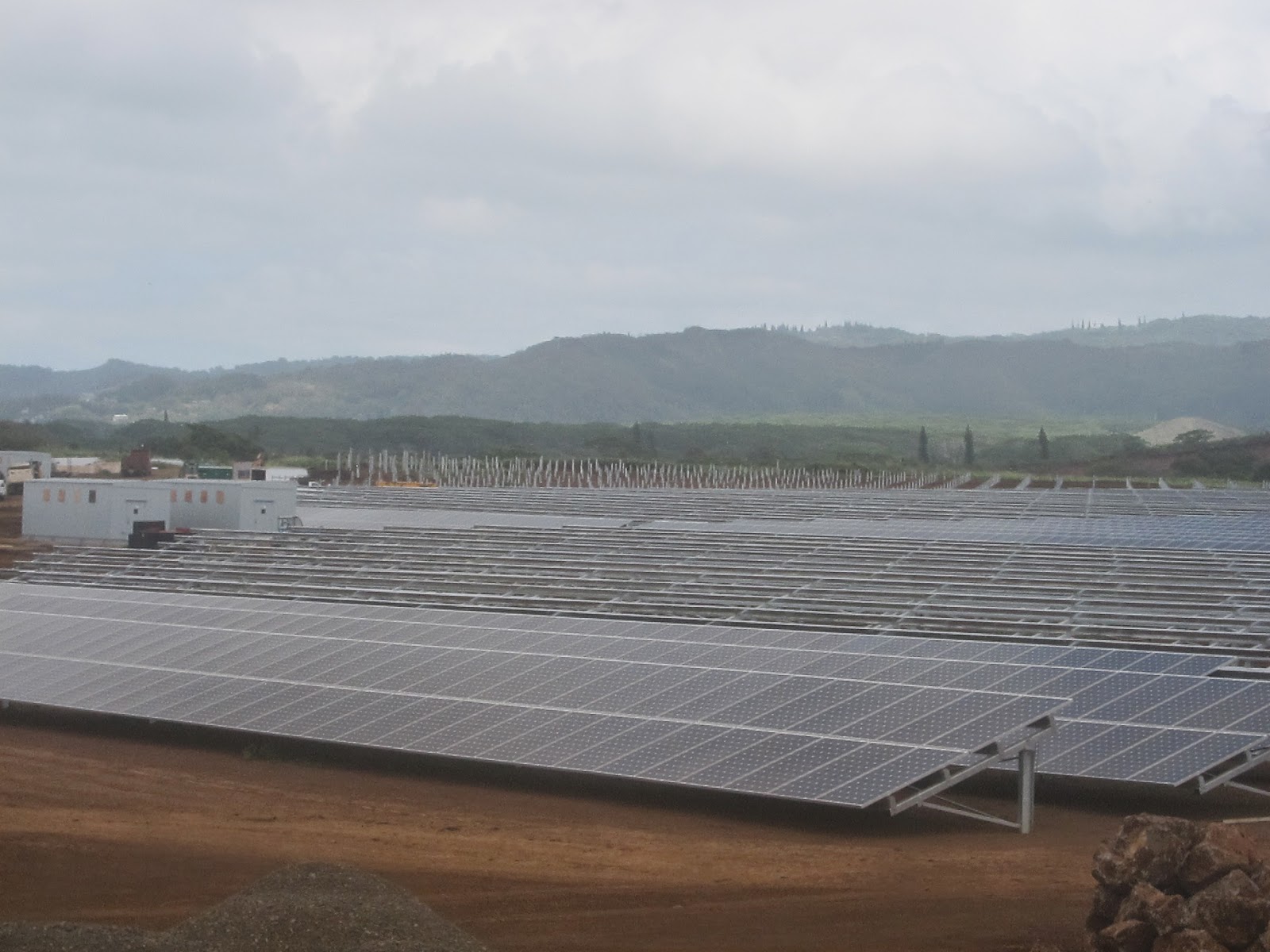
Kelly
and I left the hubbub of Green Energy and headed down the road,
toward Koloa, where 55 acres of ag land leased from Grove Farm is
being slowly covered with solar panels. It will generate about 12 mw
of electricity, and is expected to start coming on line at the end of
June.
The two
sites were about as different as night and day, like the energy they
produce. Some 54,000 American-made solar panels, each costing $500,
have been shipped to Kauai for this array, which is the first utility-scale project for
its contractor, Solar City.
By 2015,
when all of the pending solar projects come on line, they'll be
generating more electricity than KIUC can use, in the daytime,
anyway, and when the sun is shining, which is why the utility is also
focusing on storage.
"Storage
technology is now the deal,” Kelly says, and 89 companies have
responded to KIUC's recent request for proposal to build storage
capacity.
By 2023,
KIUC expects to generate more than 50 percent of its electricity from
renewable sources. It ain't be gonna be free power, or even super cheap, but it
will be cheaper, cleaner and less economically and politically volatile than burning oil, Kelly
says.
As we
pulled out onto the road, we stopped to look at the old Koloa mill,
which used to burn sugar cane bagasse to generate the electricity
that powered its operations and plantation worker camps. Though
derelict, it's still a cool-looking building, an enduring legacy of
the sugar era and a mute monument to our ever-growing gluttonous greed for bright
lights, cool air, hot water, frozen foods and electronics.
And as I snapped this photo, I couldn't help but wonder what an observer will make of Green Energy and the solar farms, a hundred years hence.








 Posts

