Monday, July 8, 2013

Musings: Pretty Shocking

It's the time of year when the horizon is crowded with clouds shaped like snake charmers, locomotives, giraffes, hearts, and the sunsets and sunrises are the same shocking pink and orange as the poinciana and shower trees riotously in bloom.

It was pretty shocking to discover that Mayor Bernard Carvalho, who previously ran parks and rec, was shocked at the condition of bathrooms in county parks. 

Hmmm. Guess he doesn't go holoholo much.

But have no fear. Rather than hold his buddy and campaign manager Lenny Rapozo accountable, seeing as how he's the well-paid county parks manager, the mayor has formed a “parks improvement team" instead.

Just like he formed a special team to deal with the vacation rentals. And just like that team was given months to come up with an enforcement plan for at one TVR, the tawdry toilets are on the same fast track.

In fiscal year 2014, according to county spokeswoman Mary Dalbert in today's The Garden Island, the county will be focusing on Lydgate.

Assessments of other major beach parks will be done in the months to come and will be addressed as funds become available.

So let's see, at one park per year, well, let's just say it'll be a couple of decades before they work their way around the island. And as usual, they start with Lydgate and Poipu, while the North Shore, which is gorged with tourists, is an after-thought.

It's not the county doesn't have money. It's been chipping in cash and staff time for the bike Path, where the quarter-mile stretch at Wailua Beach alone cost $1.9 million. Apparently it's OK for our visitors and residents to recreate, just don't urinate or defecate — at least, not in a county toilet.

And come Wednesday, County Attorney Al Castillo will be asking the Council to approve $225,000 in legal fees for Councilman Tim Bynum's suit — $75,000 for former Prosecutor Shaylene Iseri-Carvalho, $75,000 for planning supervisor Sheilah Miyake and $75,000 for the county. As previously reported, the county's tab was already at $286,000 for this suit. So if the Council approves this latest request, that will bring us to a shocking half-a-million bucks, and there hasn't even been a trial or settlement.

If it's not cash, then it must be the mayor's priorities. 

Curiously, the Path has had its own team for quite a while, though the team wasn't able to forestall numerous construction problems and delays, nor did it facilitate planning. There's also a special team for the landfill, which is still languishing.

I'm not sure what's most shocking. That Bernard allows his department heads to remain when they've demonstrated they're not up to the job, or that he's so out of touch with the state of the county that he didn't realize the park bathrooms were a wreck until he stepped in it.

Maybe he should go holoholo, check out the westside seed fields, the invasive species in our watersheds, the homeless living wherever, the vacation rentals that have consumed some of the island's most beautiful beaches.

He might find it pretty shocking.

Friday, July 5, 2013

Musings: Abuse Chronicles 20

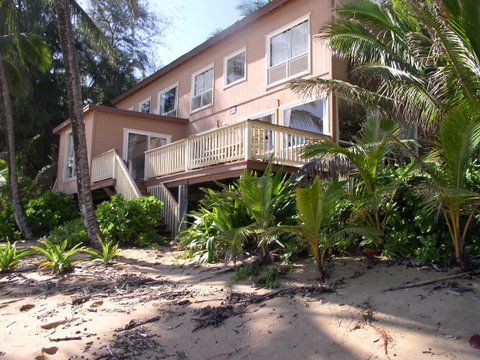
The sea is close at Swaying Palms, a “sleeps 14” vacation rental that sits on Kepuhi Point in Haena. So close that TVR ads liken it to “being on a yacht,” and waves rush under the house with enough force to move lounge chairs.

Our feet were always on the sand, and the water was only a few feet away. There is no view from any house like this one.

The sea is also close to Swaying Palms' cesspool, which was dug in 1958 for a 320-square-foot, two-room cottage. It now serves five bathrooms — each with a Jacuzzi tub — in a seven-bedroom TVR that is 10 times larger the original house.

Building permits on file at the county do not correlate with all that expansion, including a second story that was apparently added after 1995. Much of the work was done in the 1990s by Craig Maas, a builder associated with other North Shore houses that were similarly grown into TVRs without recorded permits.

A Jan. 15, 2010 comment in county records indicates the building division helpfully adjusted the actual construction costs on one 1998 permit downward from $141,000 to $112,900 — the amount needed to ensure the work qualified as an “unsubstantial improvement” not subject to flood requirements. Yet records still show the value of the permit issued remained at the original $141,000.

For a time, the house was illegally used as a multifamily TVR, renting out as many as four distinct units — Kapua, Moana, Wainanai and Kamakani, each with a kitchen. This was first documented in a 1992 appraisal and later reiterated in an Anini Aloha ad that was verified by the August 2009 FEMA audit of Kauai properties in the flood zone.

Planning inspector Bambi Emayo also found and photographed evidence of this misuse when he checked out the property earlier that year, after Krouse applied for a TVR certificate.

“The use of the Single-Family Dwelling as a Multi-Family Dwelling are [sic] a violation of density,” Emayo wrote in an April 20, 2009 violation letter. “The existing Dwelling contains (3) three units.” 

Krouse was ordered to immediately cease and desist TVR and multi-family uses immediately and remove all overhead cabinetry and cooking appliances from the unpermitted kitchens.

In a May 7, 2009 letter, Krouse denied using the property as a multi-family rental, even though he acknowledged that each “suite bedroom” had a coffee pot and microwave. Attorney Jonathan Chun apparently filed an appeal on May 21, 2009, though no copy was included in the file.

Chun's appeal and Krouse's letter are acknowledged in a June 26, 2009 letter from then Planning Director Ian Costa, who said his office had decided to recommend the Planning Commission approve the certificate after all at its July 14, 2009 meeting.

This recommendation was questionable, due to both the zoning violations and the incomplete application. Though Krouse submitted copies of his general excise and transient accommodation tax licenses, the file included no proof that taxes were actually paid. 

Interestingly, a 2006 real estate listing  claimed the property earned net profits of $90,000 in 2005 alone. Krouse also submitted documentation showing just 21 days of rental history in 2008, not the 30 days required under the ordinance.

Although the Planning Commission was supposed to scrutinize all applications that were initially denied, it unanimously approved a TVR certificate for Swaying Palms. There is no record of any new information being provided to dispute Bambi's inspection report. Indeed, approval was granted with the caveat that it was not evidence of zoning compliance.

With his certificate  in hand, Krouse continued renting out the house, which is frequently occupied by 12 to 16 persons. Four-to-six rental cars are typically parked out front, and a beach with extremely dangerous waves and currents is now frequented by tourists with small children.

However, it appears the multi-family use was retained. A February 2011 real estate listing  described it as having four bathrooms and “Spacious living area includes a private lock off guest studio with its own laundry and kitchenette.”

After submitting his 2011 TVR renewal, Krouse received an Oct. 12, 2011 letter from planning inspector Vil Baliscan — sent with Planning Director Michael Dahilig's concurrence — that referenced the old violations. Krouse was again ordered to cease and desist operations, and told his renewal would be held until he came into compliance.

A month later, Krouse wrote back, saying the denial was a “complete surprise” because the violations were the same ones that had been raised in 2009 when the planning department later “reconsidered their error....and proceeded to issue the TVR permit.” Though the file shows receipts for his payments, there's no indication of whether renewals were actually granted for the years 2009, 2010 and 2011.

On March 6, 2012, Vil sent Krouse another letter, saying a November 2011 inspection indicated that the violations apparently had been rectified.

Yet a June 2011 on-line sales ad for the house, posted by Hawaii Life, seemed to indicate the continued potential for multi-family use:

The main house consists of a spacious living area with 5 bedrooms. Across the breezeway, there are two exterior suites that have private entrances for a total of 7 bedrooms.  TVR approved, sleeps 14 people.

The MLS played up the value of the TVR certificate and absence of shoreline setback:

Built back in the 60's, so home is located closer to the ocean than is allowed now! Several owners since then have remodeled and upgraded, making this a typical Hawaiiana beach house. FINANCIALS AVAILABLE. EXCELLENT INCOME. TVR APPROVED WITH HIGH INCOME.

In December 2012, Realtor Roberta Haas sold the house for $1.9 million to California-based Tenir LLC, whose principals are Krouse and his wife. 

And so another owner is being allowed to profit from first operating an illegal multi-family vacation rental and then receiving a TVR certificate that he never proved he was eligible to receive.

As a result, on any given day, a dozen or more unsuspecting visitors are staying in a house that has absolutely no shoreline setback on one of the island's most dangerous and dynamic coastlines,

But let's just pretend it will always be calm and sunny. And try not to think about all the shishi, doodoo and wastewater generated by 14-16 people using a 55-year-old tiny cesspool, just a stone's throw from the sea.

Thursday, July 4, 2013

Liberty and Justice for All

Though the light feels like fall, the calendar says Fourth of July – the day that Americans embrace gunpowder and alcohol to celebrate their independence from colonialism, which they later inflicted on Hawaii, Guam, Northern Mariana Islands, American Samoa, Puerto Rico, U.S. Virgin Islands and the "minor outlying islands."


In keeping with the spirit of this holiday, Prosecutor Justin Kollar has authorized the release of the badge belonging to Dayne Aipoalani, alii nui of the Kingdom of Atooi. It's been in lockdown since 2008, and cost the taxpayers tens of thousands of dollars in legal wranglings, but that little piece of tin has finally been set free.

In recognition of the ongoing struggle by Dayne and other kanaka maoli to regain control of their homeland, I'm reprinting this piece by Pilipo, a Hawaiian national and kupuna:

Aloha kakou he Hawaii au,
As we approach the hoorahs of the Fourth of July as a Hawaiian National, I can not help but think of the 38,000 Kupuna before us that signed the Ku'e Petition Against Hawaii Annexation in 1897. They had witnessed a major change in government and the constant detriment against their Independence as a Hawaiian National. Although most of the Hawaiian Nationals did not own land they had access and the privilege to the use of the aina under the Hawaiian Kingdom, and most did not realize that constant deterioration would negate their own existence in their birthland.

For them, December 7 1941 was not the First Foreign invasion of the Hawaiian Islands. They had witnessed the First Invasion by a Tactical Operation Deployment of 160 U. S. Marines in the overthrow of 1893. For some on Oahu, they had been around when Kamehameha the Great did the same to gain power in uniting the Hawaiian Kingdom under one Ruler but Kamehameha did it to fellow Kanaka Maoli, and not Foreign interest of many disguises against Kanaka Maoli. Then to show deliberation and pride of their conquest, Hawaiian Nationals witnessed their First 4th of July with the enactment of the Republic of Hawaii in 1894. 

Over the past 120 years Kanaka Maoli have mutated into various specie of Hawaiian founded in Federal Appropriations of some kind or form all designed to change the pu'uwai and uhane of the Kanaka Maoli. The Federal Programs of sort  dictates the kind of Hawaiian that is needed to secure the Fraud. But yet after 120 years, the Federal Homestead Privileges of 1920 and Statehood in 1959, the questions of Hawaiian Inherent Rights to the Aina still remains like that of ka makani, aloof. While most Court decisions have been against such claims due to lack of proper documentation but not birthright, not all have failed. Some Court decisions have even declared they "lack jurisdiction in the matter of ownership" but ordered Eviction Notices to Kanaka Maoli. But why, if the overthrow of the Hawaiian Nation was so pono and 'Divine Destiny" fulfilled, why are there still loop holes in the system? It can only be because the foundation of everything in Hawaii since January 17, 1893 is based upon Fraud, and Fraud has "No Statute of Limitation". 

But Hawaiians are not alone in this scam. Americans are also "Victims of Identity" too, and yet they will celebrating their Independence in glorious fashion. At least 96% of the Hawaiian National population in 1897 knew of the scam against them and recorded their protest in the U. S. Congress. Slavery in the United States of America did not end in 1865. In fact, it tremendously increased by Federal Legislation to include the new designations of slaves registered as U. S. 14th Amendment Citizens enacted in the 1866 Civil Rights Act and later sanctified as "Corporate Inventory" under "Act 1871", in February 1, 1871 by President Ulysses S. Grant (U. S. Grant?)     
             
The Free Public of the United States became Slaves. A Country "for" Free People became a Corporation "of" Slaves. Chains and shackles were no longer necessary because the minds of freemen were /are controlled as Pavlov's Dog without the whistle, as that of the Corporation's subsidiary, "STATE OF" (HAWAII)  

Kana'iolowalu [Hawaiian roll call] is the death of Kanaka Maoli and declared Hawaiian Nationals. As long as "People of Truth" stand-up, we are a lei of lima (hands) and will not fall. We stumble a lot, but never fall. Kana'iolowalu is a Corporate Entity of the Corporate State of Hawaii. It is no more than that what the State of Hawaii is to the Federal United States of America. They are using the existing Sovereign Kanaka Maoli and Hawaiian Nationals against themselves to impose their Corporate Legislation (ACT 195) to control the people by nullifying their"Living Soul Identity", just as the Legislation of the Federal Corporation of the United States of America did to "once Sovereign Americans" by imposing their U. S. 14th Amendment. ACT 195 or Kana'iolowalu uses Hawaiians to legitimize the disposal all Crown Lands that will also terminate all Hawaiian Inherent Right Claims. If there is no Bona Fide Identity there is no Bona fide Claimant!


Kaulana Na Pua!
malama ke kino,
pilipo

Wednesday, July 3, 2013

Musings: Pathological

Today's newspaper article on the opening of the Path along Wailua Beach exemplifies a core problem with tourists: no matter how much you give them, they want more.

Which is why you have clueless twits walking on a section of the Path that further desecrated a sacred area — and cost a sickening $1.9 million for that quarter-mile segment alone — and though they “love it,” they're still bitching.

“They need a bike rental business right there at the end of the beach,” said Canadian visitor Debbie Dykes, pointing to Wailua River.

“They shouldn’t allow so many cars,” opined South African surfer Amy Oakes, who plans to spend five months here with her boyfriend, taking up space, using up resources and spending as little money as possible before moving on.

The Garden Isle is so beautiful, with so many mountains and beaches, but the number of cars on the road ruin a little bit of the island’s vibe, Oakes said.

Gee, Amy, sorry if we're disturbing your idyllic vacation as we go about our lives and jobs, our view of Wailua Beach now ruined by that stupid fake pohaku wall that borders the Path you're traipsing on.

I think some of us might say the island's vibe has been ruined more than a little bit by culturally insensitive development and the ever-increasing hordes of tourists, whose sunscreen stink can now be smelled on even the most remote beaches and trails as they seek always to find someplace new, different, “secret.” Only to discover many more just like them wherever they go.

Don't get me wrong. I don't hate tourists, and I'm fully aware that they're an “economic driver” of this island— just like the toxic seed companies, military base and ice dealers. (Btw, check out this Huffington Post article about Hawaii's dirty little GMO-pesticide secret, which gives Kauai a serious black eye.)

But I wonder why Kauai and state "leaders" have this idea that more tourism is always better — even though locally, we're told, the visitor count was way up last month, meaning more resource demands and impacts, but their spending was way down. So how is that benefitting us again?

Meanwhile, Mayor Bernard Carvalho Jr. keeps building his outrageously expensive, disconnected, unplanned path to nowhere — a perfect metaphor for his administration — even as the new landfill, adolescent drug treatment center, park maintenance, affordable housing, agricultural boosterism and zoning enforcement languish.

Main thing, the tourists are happy. Even if they're not.

Monday, July 1, 2013

Musings: Thump Thump

It was all about orange this morning, save for the waning white moon that clung to a patch of blue, and that was even before the rising sun fired up the clouds like charcoal briquettes in a grill. The dogs and I saw it all on our pre-dawn walk-run, which began with a pig encounter that got all of our hearts thumping.

Poor Kauai is bound to take a thumping with the governor's appointment of developer Shawn Smith to the state Board of Land and Natural Resources. Smith and his buddy Larry Bowman are Falko Partners, which is currently trying to sell a big chunk of land at Koolau, just west of Larsen's Beach, for a cool $67.5 million. As the listing at ebillionairesclub.com gushes:

KAHUAINA PLANTATION 360 acres of pristine secluded Kauai coastline 80 luxury homesites [CPR lots] ranging from 1 to 7 acres Nearly a mile of coastline with 2,500 linear feet of white sand beach for all lot owners Ocean and mountain views from each intimate, private homesite Entitlements provide high barriers to entry.

Gag. There goes more good ag land into upscale gentleman's estates.  

Kealia's Valley House, now on the market for $25 million — “Of particular note, a vacation rental permit has been secured for the estate, and additional residences may be built if desired, adding to the future ownership options for the property.” — is another one of Falko's community-minded ventures.

Smith replaces architect Ron Agor, who replaced timeshare developer Lynn McCrory, on the board responsible for overseeing the state's most sensitive public lands. Are you starting to see an ugly pattern here? As a friend observed, “The state works in mysterious ways.”

Though no doubt Sen. Ron Kouchi put in a good word for his buddy Shawn. Their cozy relationship was revealed five years ago on this blog by a reader who happened to be reading Shawn's smart-phone over his shoulder when the Council was reviewing the ag subdivision moratorium bill:

“Shawn is so close to [then] councilman Ron Kouchi that he felt he could send him text messages DURING THE MEETING. For example, after Ron made a point against the bill, Shawn sent him the message "Kick ass! [I love it] when you get rolling." In the address book is almost as good as in the pocket.

“To another lucky text recipient, possibly Larry Bowman, he spilled the beans: "Here's my secret - I wrote that letter blasting Bynum." 

Sure enough, today's TGI has a criticism of Bynum attributed to one Brian Flournoy of Kapa'a. Previous letters by that alias have the same vitriol against ADU sunseting and ferry protestors.

What a stellar guy. I'm sure he'll represent our island admirably.

The Kauai Humane Society has taken to the newspaper to defend its proposal to hike dog licensing fees against the thumping it took from hunters at last week's Council meeting. KHS director Penny Cistaro admits they never consulted with the hunters before hatching this revenue-raising plan, even though hunters will be hit hardest.

I know she's new, but surely someone at KHS should have advised her that hunters are a well-organized voting constituency, as evidenced by the strong turnout at the Council meeting. But rather than say, OK, maybe we should sit down and talk, Cistaro takes the defensive pit bull stance:

“The community, with the exception of the feedback that was given at the council hearing, has all been positive,” said Cistaro, adding she has not received calls from hunters since the bill was introduced.

And why would they call you when you never call them? Besides, not all the community response has been positive. KHS is another organization that lives in an echo-chamber, as exemplified by the older haole lady from Lihue who testified that she didn't understand “why they need a huge pack of dogs for one hunter, one person.”

As one of my friends observed, “Well, she wouldn't now, would she?”

In case you haven't noticed, Kauai has big wild pig population, and the hunters are the only ones keeping it in check. Yes, some hunting dogs are treated poorly, but so are the house-yard dogs that are overfed, under-exercised and bored. KHS needs to move past the mindset that hunters = bad.

Speaking of bad, it really makes me want to give food manufacturers the thump-thump treatment when I hear them whine and cry about how they can't possibly label GMO foods because it's too expensive and difficult.

Well, not only are they labeling their GMO junk in Europe and elsewhere, they actually have entirely different formulations of their products for markets that have banned the preservatives, additives and other crap that the Food and Drug Administration sanctions in the U.S.  

For example, the Betty Crocker cream cheese frosting sold in Britain has none of the hydrogenated oil, corn syrup, yellow dyes and sodium benzoate of its American counterpart. (Though neither contains any cream cheese.)
And the fries sold at McDonald's in America are made with an anti-foaming agent, "natural beef flavor" and unhealthy transfats, whereas the UK fries are not.

So why do food manufacturers insist on selling Americans this crap? And why does our government allow it? 

Another good reason to grow your own, hunt your own, make your own food.

Saturday, June 29, 2013

Musings: On Media Relations

“Come on,” I said to the dogs, though they never need urging to go anywhere. “It's gonna be a beautiful sunrise.” And it was, with gauzy clouds turning the color of a blood orange and the ones covering the sun getting that red-gold gilt around the edges and still others forming towering cumulus columns that hovered on the horizon while a double rainbow arched mauka and iwa flew silently overhead.

So started a new day on Kauai, and at The Garden Island, too, where publisher Casey Quel Fitchett was fired yesterday — an event publicly celebrated under the “breaking news” headline: Ding dong, the witch is dead! (Click on image to enlarge.)

The article, which was quickly taken down from the paper's website, sarcastically ridicules the “positives” associated with Oahu Publishing Inc.'s (aka Star-Advertiser media monopoly) purchase of the paper:

“You may also have noted we've grown in the number of pages, increasing both outsourced editorial content and ads that help readers save precious dollars without requiring any local investment by the company. For the first time since their accounts were lost to OPI on Quel Fitchett's watch, Kmart and Longs advertising inserts are once again part of your Sunday TGI, because Quel Fitchett losing those contracts to OPI's Midweek is what strengthened OPI while weakening TGI enough to make the purchase possible.

Our foremost goal is to produce a newspaper that makes Kauai proud without actually investing in the product. How are we doing so far?”

I think we all know the answer to that one, sadly.... 

Oh, well, I'm sure OPI can round up somebody from South Dakota who has always wanted to live on Kauai to take Casey's place. Most likely a man, since OPI is such an old boy's club. Yup, owner David Black couldn't find even one wahine to round-out his all-male board of directors. What's up with that?

Meanwhile, OPI's MidWeek Kauai is going through a change as well, with writer Amanda Gregg and her hubby, deputy housing director and former deputy planning director Imai Aiu, headed for Boston. Guess now we'll never know why Imai approved all those vacation rentals even though the owners failed to prove they were eligible for a non-conforming use permit.

But OPI and Obama aren't the only ones worried about and clamping down on whistle-blowers and leaks. Kauai County has issued its own media relations policy that channels everything through the mayor's office. 

Under the First Amendment-stifling directive — approved by County Attorney Al Castillo — all county employees are forbidden to “proactively distribute information or initiate discussions with media representatives concerning County issues without first consulting with the County of Kaua`i Communications Team – and in particular, the Public Information Officer (PIO).” It goes on to state:

Spokespersons, staff, and members are not to give statements “off the record.” Any discussions, whether in an informal or formal setting with media representatives, will be considered on-the-record (even if the media representative says that the discussion is “off the record”).

It doesn't specify what punishment will befall those who deviate from “the process." Perhaps they'll be sentenced to sit through 10 County Council meetings without a smart phone for diversion.

I understand the role and value of a PIO, and in all fairness, the “communications team” — Beth Tokioka, Mary Daubert and Sarah Blane — is efficient and responsive. But surely managers making $100,000+ per year can be trusted to talk the party line to reporters. 

And what of those agencies — county council, auditor, KPD, prosecutor — whose staff are technically county workers, though they're not under the purview of the mayor's office? Does all the information from these departments have to be vetted by the mayor's office, too, even though he's their political enemy?

Whether it's Obama or Bernard, it seems we'd be better off if people focused more on doing the right thing, as opposed to tightly controlling the information that's released to the public. Because it is our government, after all.

While we're talking about doing the right thing,  the Department of Hawaiian Homelands yesterday nixed Eric Knutzen's plan to lease Anahola homelands to harvest and cultivate trees for his wood chip-burning plant. For years homesteaders have been protesting their lands being leased to non-Hawaiian grifters. 

Finally, DHHL listened. Or, rather, five of the eight commissioners did.

Thursday, June 27, 2013

Musings: Suspicions

So what really happened out at Polihale last weekend? Though The Garden Island published the account of a woman whose brother was reportedly there, both the police and prosecutor say actual victims and witnesses have been extremely reticent to speak up. Police say this leads them to suspect there's more to the story than has been revealed, such as perhaps the victims weren't entirely blameless, or were engaged in illegal activity themselves.

Though the sister told the paper that cops did not show until 5 a.m., Police Chief Darryl Perry said “we arrived about 20 minutes or so after the call was received because it was in a remote location and checks did not reveal anything to the extent that was reported.”

He said an eight-second video clip had been turned in, but it didn't show much.

The episode got me thinking about Polihale, which I understand to be a leina — a jumping off place for souls. But like so many other sacred spots, it's now been overrun by casual  tourists and yahoos with no respect for the place. Sad.

Also sad was seeing all the folks wearing different-colored tee-shirts to separate themselves from others at yesterday's County Council meeting on the pesticide-GMO bill. It passed on first reading — kudos to the Council for not chickening out — and is headed for a marathon public hearing on July 31. 

Maybe people could wear purple to that session as a reminder that even though we hold different views on this issue, we're all living on this little island together. This debate is going to continue for quite some time, and it would be nice if it didn't completely rip the community apart. Because isn't it ultimately about what's best for Kauai? By which I mean her, Mama Aina.

Given some of the Facebook chatter, it seems the meeting was a wake-up call for anti-GMO activists, who were surprised at the strength and intensity of opposition to the bill. It's so easy, when caught up in the Facebook/KKCR echo chamber, to believe that everyone else thinks the way you do. Though the testimony was tedious at times, new information did come to light and everybody got a chance to see that passions run deep on both sides of the issue.

One of my favorite moments was when Councilman Ross Kagawa said he still had faith that some of the state and federal officials “are not corrupt, like those who care about the seals and shearwaters.” Little does he know that the suspicions extend to those folks, too.

Speaking of which, upon checking my Anahola post office box, I found a full color brochure and form letter from Eric Knutzen touting the supposed benefits of leasing Hawaiian Homelands to harvest albezia trees for a woodchip-burning power plant in Koloa. The mailer had lots of pretty pictures, as promotional literature typically does, but failed to address concerns raised by beneficiaries — concerns that no doubt will be raised again at tonight's meeting at Kapaa Elementary School.

The website it refers people to is similarly short on substance. But then, Eric, who runs KCC's Ho`ouluwehi Sustainable Living Institute, has proved evasive and slippery in discussing his Green Energy Team project. After stringing me along for a month when I was working on an article for Honolulu Weekly, he ultimately refused to answer some pretty basic questions:

Some of the concerns raised by Anahola community include possible contamination of the bay due to mud from the cleared lands. What is the scenario for clearing and replanting, and how will you prevent erosion? Will you be chipping on site, or transporting logs? What other improvements are planned, in terms of roads and water lines, and what is the dollar value of these improvements? Do you anticipate the need for irrigation, and if so, where will the water come from? Are you anticipating the acreage (aside from the 267 acres for lots) will be planted or cleared when the lease term ends?

Please explain your feed stock scenario. How many acres total are needed to supply the facility on an ongoing basis? I understand you have an agreement with Hawaiian Mahogany -- how many acres does that include, and how long will that supply the facility? I saw a reference to 2,500 acres of short-rotation biomass -- how long does it take to grow the feedstock you need?

If you don't get the lease with DHHL in Anahola, do you have a back up plan for acreage elsewhere? Have you approached Grove Farm?

What is happening with the 1,037 acres at Kalepa you leased?  Some of the tenants up there have complained that Green Energy initially promised to pay for the improvement and upkeep of roads, but now GE is proposing that those costs be shared. Is this correct?

How did Green Energy get the federal loan guarantee? Does it essentially ensure that the two main partners -- GBC and Green Energy -- won't be left with any financial liabilities if the project fails? Is the project eligible for or receiving any state or federal tax incentives for biofuel projects?

What byproduct, if any, will be generated from burning the feedstock at the plant, and what will be done with this product?

If this project is so fantabulous, why the lack of transparency? After all, it plans to sell power to KIUC at an undisclosed price that we ratepayers will pay, and it's benefitting from a $73 million federal loan guarantee.

Eric also keeps repeating the fiction that this plant will “lower energy prices.” I asked KIUC's Jim Kelly about that claim and got this reply:

Burning wood and not oil will certainly stabilize bills and reduce the whipsawing effect of oil prices. But if the price of oil – which we’re still going to have to buy – is $200 a barrel in 2015 then everyone’s bill is not going to go down.

Eric also likes to claim the project is "carbon neutral," in reference to the amount of fuel oil that KIUC can save. But he has not yet explained how the fuel used by trucking and chipping factors in to the project's overall carbon footprint.

I understand that some are supporting the albezia-clearing as a way to get homesteaders off the waiting list and onto the land, which is laudable. But the overall project looks and smells suspiciously like a boondoggle.

Wednesday, June 26, 2013

Musings: Little Nuggets


If folks wonder why the chemical/seed industry has been allowed to operate pretty much unchecked in Hawaii, consider this: Laurie Yoshida, formerly Gov. Linda Lingle's rep on Kauai, is now the island spokeswoman for DuPont Pioneer.

In other words, they're all in bed together.

The Garden Island included an interesting comment from Laurie in its article on the pesticide bill coming before the County Council today:

Yoshida also questions the county’s liability should it pass a bill it can’t enforce.

I'd actually love to hear more about that, since the county passed a vacation rental bill it obviously can't enforce and has adopted new zoning rules that define a carport with a refrigerator as a kitchen, which it most certainly can't enforce.

No doubt there are more examples. But where exactly does the liability come in?

In both that TGI article and a piece that ran yesterday in the Star-Advertiser, industry reps never actually came out and said their operations were safe, or that citizens had no cause for concern. No, all their comments were focused on legalities, costs and whether the county should enter a regulatory arena dominated by the state and feds:

Tom Matsuda, pesticides program manager of the state Department of Agriculture, questioned how Kauai County will regulate pesticide use. "We're talking about overregulation," he said.

The Council meeting will most certainly draw a large crowd, but there's one important thing to keep in mind: a great many people will be paid to attend and defend the status quo, while the citizens, as usual, will be present on their own dime, their own time, to advocate for change.  However, my prediction is that the bill will be deferred, no matter how many people show up.

Though the U.S. Supreme Court's decision today likely won't change anyone's mind about the definition of marriage, it did strike down a discriminatory provision in federal law that prevented legally married same-sex couples from receiving federal benefits. It's another step forward in equal rights for all, much to the dismay of some conservatives. I was interested to read this in the Associated Press coverage:

The rulings came 10 years to the day after the court's Lawrence v. Texas decision that struck down state bans on gay sex. In his dissent at the time, [Justice Antonin] Scalia predicted the ruling would lead to same-sex marriage.

As the old saying goes, you can't stop progress.

A new study conducted by Friends of the Earth International tested the shishi of 182 city-dwellers living in 18 different European cities and found glyphosate — Roundup — in 44% of the samples. As reported by a Wall Street Journal blog:

“This weed killer is being widely overused,” said Adrian Bebb, spokesperson for Friends of the Earth International. And that’s even though hardly any genetically modified crops are grown in Europe. Doing so on a grand scale would increase the use of Roundup around eight-fold, according to Greenpeace.

I wonder what we might find if we tested American pee — especially farm workers and people living in agricultural areas.

Just when you despair that women are losing their right to choose, Texas state Sen. Wendy Davis, backed by the "boisterous chanting" of a crowd mobilized in part by social media, managed to filibuster a bill aimed at restricting access to abortion in that state.  The Republican Lt. Governor blamed "an unruly mob...using Occupy Wall Street tactics" for his losing control of proceedings.

As the not-so-old saying goes: You can't keep a good woman down.

And finally, I loved this little nugget: Hong Kong didn't send whistle-blower/leaker Edward Snowden back to America because there were errors in the extradition paperwork, as in a wrong middle name and no inclusion of his passport number. So much for the intelligence service....

Tuesday, June 25, 2013

Musings: Tooty Fruity


Though a lot of folks complain about the chickens, and I've got two fighting rooster farms within earshot, it's remarkable how the joyful warbling of the shama thrushes drowns them right out. Perched in trees on all sides of the house, their intricate melodies offer dawn-to-dusk entertainment, a constant reminder to stop, look, listen, appreciate, slow down, enjoy.

Lately I've been enjoying longan, golfball-sized lychee, lilikoi, papaya, mango and purple cainito, which the neighbor who supplies me calls cream apples. It seems to be a bumper year for fruit.

And fruity ideas. Like the proposed bill that would allow the Kauai Humane Society to seize any dog without a license and take it to the shelter — even if you are right there with it, and even in your own yard, if it's unfenced.

That seems like a pretty heavy-handed approach. Presumably they're already picking up dogs that are cruising without humans. So why try to nab people's pets when they could just sell them a license on the spot? If you want us to pay more for licenses, that's one thing, but don't be grabbing more power in the process.

KHS, which has long had a strained relationship with hunters, also appears ready to burn those bridges completely with its new license fee schedule, which would hit hunters with packs the hardest. Sure, some of them are irresponsible, but not all, so it feels unfair to ding them as a group. I understand KHS is trying to encourage people to get their pets fixed, which is great, but how are people supposed to prove their female is spayed if they've lost the paper from the vet?

Meanwhile, cats get a totally free ride and are allowed to roam with impunity, even though feral cat control is a significant cost for the shelter, one that dog owners are now being asked to subsidize. If dog owners must buy a license, shouldn't cat owners be held to a similar requirement?

Another fruity proposal has already been adopted by the county, and that's an administrative rule change that expands upon the definition of a “kitchen.” Now you can be busted for a zoning violation if you have a microwave, hot plate, toaster oven, mini-fridge, electric griddle, deep-fryer and yes, even a rice cooker, in any room other than a kitchen. Like, say, the carport or family room. But get this — only if it's plugged in. Or if you don't pay a suitable bribe to the inspector.

And finally, the state Agribusiness Development Corp. has been operating under the fruity notion that its lessees don't have to pay property taxes. As in the three chemical/seed companies leasing some 6,000 acres on Kauai — most of it so-called “ceded” lands. Not so, says Councilman Gary Hooser, who notes that private users of public lands must pay property taxes. As a result of his inquiries, the county has sent out notices to the three affected companies assessing them for two years of taxes, with penalties and interest kicking in if they don't pay within 30 days. The back taxes total about $140,000 — enough to help fund Gary's pesticide disclosure/GMO moratorium bill.

State law also requires those who lease public lands to comply with all environmental laws, including Chapter 343. As Gary notes, there are just three ways to comply with 343: an exemption, an environmental assessment or an EIS. The ADC has required none of the above from the seed companies. Though it's too late to go after them now, any new leases will be scrutinized to ensure compliance.

Monday, June 24, 2013

Musings: Here and There

Super moon, hidden all night by a blanket of gray fleece, emerges just before dawn to show her full, cool whiteness, lighting the way as the dogs and I walk along a ribbon of black road. And then she is engulfed again by clouds that later bring a rainbow and part long enough to reveal two thick waterfalls streaking down the green face of Makaleha.

If you think that genetically modified foods are safe just because the Food and Drug Administration says so, think again. FDA-approved ingredients used in up to 80% of all American convenience food have been banned by other countries, according to a new book “Rich Food, Poor Food.”

We're talking about stuff like brominated vegetable oil, a substance found in Mountain Dew, but banned in more than 100 countries because it has been linked to thyroid disease. And the dyes yellow #5 and yellow #6 — derived from coal tar – that makes Kraft mac & cheese so cheerily bright. Then there's asthma-inducing azodicarbonamide, a bleaching agent that is common in many processed American foods, but banned in most European countries. In Singapore, its use carries a $500,00 fine and prison term of up to 15 years.

Ironically, even as America feeds its citizens the kind of crappy food that makes them sick, it makes health care prohibitively expensive and attacks every effort to even explore a single-payer system..

Meanwhile, we've also seen other nations move to prohibit and restrict genetically modified crops and products — or at least require labeling — and ban certain pesticides that are allowed here.

So why is the U.S. so out of step? What is so different about here and there? Surely there can't be that much debate about the science. What seems far more likely is the regulators in America are in bed with industry.

Just something to keep in mind when the County Council takes up Gary Hooser's pesticide disclosure, buffer zone and GMO moratorium bill on Wednesday. No doubt the chemical/seed companies will make their usual argument: our operations are already regulated by the state and the feds.

It's true, they are. But that doesn't mean the regulations in place are sufficient to keep us and the land and water healthy and safe.

If you'd like to weigh in on the proposed bill, send emails to counciltestimony@kauai.gov. 

Friday, June 21, 2013

Musings: Insider-Outsiders

Councilman Gary Hooser got his pesticide disclosure/GMO moratorium bill off to a strong start, with a well-written article in The Garden Island and support from the national Pesticide Action Network (PAN), which has put up a flash Stop Poisoning Paradise website and is doing media outreach.

Now we'll see whether the rest of the Council — Tim Bynum is a co-sponsor — goes along next Wednesday. A majority must approve Bill 2491 on first reading, which then gets it a committee assignment.

It's a bold bill, and I give Gary a lot of credit for introducing it. Especially since we do not have a bold county government. 

Gary reportedly asked Chair Jay Furfaro for at least 90 minutes of meeting time as folks from the Center for Food Safety are flying in give the Council a presentation on pesticides and GMOs. But Jay allocated just 20 minutes.

And the bill hadn't been out an hour before I started hearing a buzz from official quarters that the GMO moratorium part is most likely illegal. The chemical/seed industry, which has some of the best lawyers that money can buy, will no doubt do everything in its power to stoke the fear of a monumental lawsuit. Unfortunately, such tactics are frequently successful with Kauai County, which is terrified of being sued.

Already we are hearing Jay and Mayor Bernard Carvalho Jr. say that pesticide regulation is really a state function, which is not very secret code for "we don't want to touch it."


In its press release, PAN notes  "this all-volunteer, citizens’ effort expects a lot of opposition from pesticide-GE seed corporations." That's true, although watch for significant opposition as well from farmers, ranchers, pest control companies, golf course owners and all the myriad people who use and sell pesticides, as well as those with economic and job concerns. Oh, and let's not forget the powerful landowners: A&B, Grove Farm, Kamehemeha Schools, Gay & Robinson, the state. None of them want to lose lessees willing to pay top dollar for land.

And I'm not sure it truly qualifies as "an all-volunteer, citizens' effort" if PAN and Center for Food Safety are involved. That doesn't bother me personally, as both groups do a lot of good and the local movement needed direction.  However, this is provincial little Kauai, which tends to circle the wagons when it thinks outsiders are trying to come in and run things.

Of course, the chemical companies are also outsiders, but they're the outsiders that the state has courted and supported, which makes them insider-outsiders, especially since they're spending money.  

I believe there is a lot of community interest in the pesticide issue, though this bill addresses only restricted use pesticides applied by companies that purchase more than five pounds or 15 gallons annually. Or in other words, Kauai Coffee and the seed companies. 

State records show these companies use a lot of gnarly stuff, in sizable quantities, including atrazine, Dursban, Lorsban and other proprietary chemicals. According to court documents filed in the pesticide dust lawsuit against Pioneer, that company applied pesticides to its West Kauai fields on 67 percent of the days in a year.

And when they're controlling some 12,000 acres from Lihue to Mana, the impact is going to be significant. People have both the desire and the right to know what these companies are spraying, as well as when and where. Experimental pesticides are another serious concern, as these haven't gone through the full federal regulatory process.

I worry, however, that the pesticide issue — which is very quantifiable, with lots of scientific data showing impacts — will be overshadowed by the GMO issue, which isn't quite so cut and dried, at least in terms of scientific studies.  I would have preferred to see separate bills, though it can be a political strategy to drop the sticky part of proposed ordinance to get approval on the rest.

I also think it's questionable to have Kauai County conduct an EIS to ascertain the impacts of growing genetically modified crops on the island. Typically that burden and those costs are borne by those who are proposing a use. The language in the bill relating to an EIS is also really broad, including testing human volunteers for pesticide residues. I'm not an attorney — as some commenters like to remind me — but I think it would be tough to prove that a person's pesticide burden can be directly linked to the cultivation of GE crops. 

But my biggest concern about the bill is how it gives permitting oversight and other responsibilities to the Department of Public Works — the same guys who were approving vacation rentals with enclosed downstairs in the flood zone, the same guys who now spray Roundup on county parks and roadsides.

Let's face it. The county totally sucks at enforcement.  I've already heard that the anticipated enforcement for this bill will be self-regulation by the industry. 

First, though, it has to pass, and while I'm a perennial optimistic, I'm also a pragmatist. The seed companies have deep pockets and years of experience running propaganda campaigns. More important, they hold the all-powerful westside employment card.  And when it comes to choosing between money and the environment and human health, well, we know which one has always won in Hawaii.

To use an agricultural idiom, getting this bill through the County Council is gonna be a tough row to hoe.

Thursday, June 20, 2013

Solstice Sun

Leap! With faith and one great cackling whoop, enter the waxing dark. — Marian Spadone, We'Moon

Musings: Castillo's Spending Spree

Honolulu law firms are benefitting heavily from Kauai County Attorney Al Castillo, who has requested more than $421,864 to hire special counsel just since January.

Al's office has spent $631,509.13 on special counsel to date for fiscal year 2013, according to documents from the finance office. This has him handily beating his previous record of  $525,478.94, set in FY 2010.

Special counsel is brought in when the county attorney lacks the skills to handle a case or has a conflict of interest. Sometimes it's due to laziness, or because his staff has other priorities, such as cursing citizen whistle-blowers and making up power points to justify their crappy legal advice on the vacation rental issue. Other times, it's because the county attorney and/or his boss — Mayor Bernard Carvalho Jr. — make really bad decisions that result in extensive and/or protracted litigation.

In Al Castillo's case, it's all of the above.

So where is all that money going?

To find out, I submitted a public records request to the County Attorney's office for all the special counsel funding sought from the Council since January 2013. I know the records exist in electronic form. But rather than email me PDF files, Al insisted I pay $7 to have his staff make photocopies of 18 pieces of paper, which I would then have to review at his office in Lihue.

I'm not sure whether Al was trying to pull a petty power play or throw up a roadblock or both. But I got the information for free elsewhere, and it speaks volumes about the sad state of this county.

The biggest chunk — a whopping $211,000 this year alone — is due to Al's handling of Councilman Tim Bynum's case against the county, which could have been resolved long ago. But Al is weak, and afraid to face the political fallout of a settlement. So instead he has sought $111,000 to defend former Prosecutor Shaylene Iseri-Carvalho, $50,000 to represent planning supervisor Sheilah Miyake and $50,000 to lawyer up the county.

When you add the $211,000 for the first six months of this year to the $75,000 requested last fall — $25,000 for each defendant — the tab for special counsel in that case is now up to $286,000. Must be getting close to the county's insurance deductible.

Let's see, what else? There was $15,000 to keep fighting the sex discrimination case filed by Kathleen M. Ah Quin against the county bus back when the agency was run by the mayor's gal Janine Rapozo, who was transferred — go figger — to the human resources office.

Then there was $20,000 for the police commission to challenge the mayor's decision to suspend Police Chief Darryl Perry and Assistant Chiefs Roy Asher and Ale Quibilan — in addition to the $45,000 requested last year.

And let's not forget $25,000 to represent Officer Chris Calio, the cop who shot an unarmed man on his roof when the police department was essentially leaderless, with the top brass on mayor-ordered suspension.

Another $44,944 was sought to represent the County Council in the hostile workplace claim filed by Ron Rawls against County Auditor Ernie Pasion “and related matters.” With the $15,000 from last year, that brings us to nearly $60,000 in legal fees for that office.

Al also requested $61,000 so far this year to represent the county in Jeffery Sampoang vs. Harvey Brothers, LLC: et al.; $36,000 in Ricky L. Ball vs. Kaua'i Lagoons Resort Company, Ltd. (in addition to $25,000 last fall), and $8,920 in Wayne R. Daniel v. Kodani and Associates, Inc., et al., on top of $54,680 for that case from last fall. 

Unfortunately, most if not all of these cases remain unresolved, so the meter is still running and the settlements have yet to be paid.

While digging around, I was amused to find this reference in a Dec. 1, 2010 story on the Council's 6-1 vote — with Councilman Mel Rapozo opposed — to reconfirm the mayor's appointment of Al as county attorney:

County Attorney Al Castillo will also keep his job. Castillo got the job in March 2009, and since then the County Attorney’s Office has relied less on outside counsel, a practice that can easily drain hundreds of thousands of dollars from county coffers in a single litigation, he said.

Indeed.